Wuthering Heights
Three Bags FullWuthering Heights is the novel Rebecca reads aloud to George’s flock, and it becomes an unlikely interpretive key: Miss Maple draws on its account of ghosts to explain why George’s murderer might have used a spade, while the book’s ending gives the sheep a language for imagining his soul at peace. For the flock, the novel is not merely a human story. Its words alter how they understand the crime they are trying to solve and the loss they cannot resolve.
The Book Enters the Flock’s World
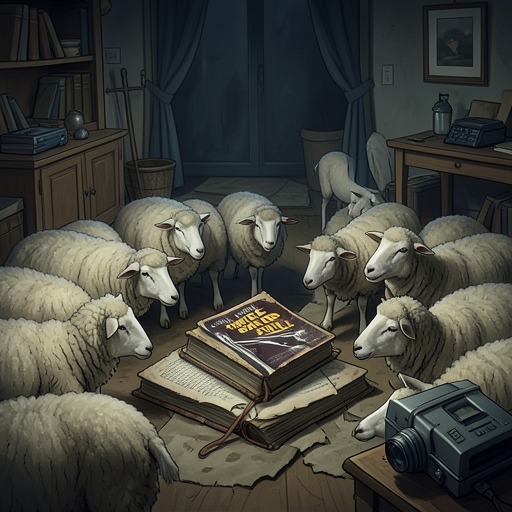
Rebecca chooses the book after the flock has been promised further reading. She goes back into George’s caravan and returns with it, opening it somewhere in the middle rather than at the front. The sheep notice the breach of what they consider the proper order of reading, but their tiredness and pleasure at hearing a book again outweigh their protest. Their tolerance makes the scene gently comic, while establishing how seriously they take reading as a shared activity—and how much they depend on Rebecca to continue it.
The passage holds the sheep’s attention through a language of haunting and despair. Rebecca reads Catherine Earnshaw’s appeal to the dead, including the assertion, “The murdered do haunt their murderers, I believe.” The novel’s speaker begs the ghost to remain in any form rather than leave her alone in an abyss. Outside the caravan, the moon disappears behind a dark cloud; the only light on the pages comes from the small glowing point between Rebecca’s lips. The sheep watch her in that dimness and associate her appearance with the narrow-eyed, melancholy Siamese pirate they know from another story. The scene places a human book’s Gothic terror beside the flock’s imaginative world, without making the sheep’s fascination any less sincere.
Rebecca closes the book and says the passage is too sad; she does not need a book to tell the sheep sad stories. After a silence, she begins again in her reading-aloud voice, but without the book. The distinction matters: the novel has prompted an emotional response even as Rebecca steps away from its pages. Its effect will also outlast the moment of reading, returning later not simply as sadness but as a structure the sheep can use to reason.
A Ghost Story Becomes Evidence
When Miss Maple later says she has worked something out, she credits the book directly. She would not have thought of it without the passage, she explains, and connects that discovery to George’s will requiring Rebecca to read to the flock. The other sheep do not immediately follow her reasoning. They remember separate parts of the reading: Maude recalls the reference to resting, Zora the abyss, and Cordelia the claim that the murdered haunt their murderers. What had sounded like a sad human scene has become a set of clues that the flock can assemble.
Miss Maple links those clues to the spade. The flock had wondered why George was stabbed with it if he was already dead. Her explanation is that the murderer feared being haunted and imagined that pinning George to the ground would stop his ghost from returning. That conclusion turns the spade from a detail of the killing into evidence of the killer’s belief: in Miss Maple’s reconstruction, it was meant not only to injure or hold a body, but to prevent an afterlife from reaching its murderer.
The novel supplies the answer to that imagined precaution. Miss Maple reasons that a victim can haunt a murderer in any form, and George no longer needs his own. Because George loved his sheep better than human beings, she concludes that he is haunting the murderer as a sheep. The flock’s question therefore shifts from how a ghost might return to which person is being haunted. Wuthering Heights does not identify the culprit for them; it gives Miss Maple a model with which to reinterpret the crime and redirect the investigation.
Reading Again, and Imagining an Ending
The flock’s relationship with the book continues after that revelation. As the stories about Glennkill in the newspaper grow shorter and more boring, Rebecca returns to the novel that impressed the sheep earlier. In daylight they can see its cover clearly: greenery, a brook, mountains, trees, and rocks. The inviting landscape contrasts with the fact that the story is about humans again, this time a small flock of people living on the moors. The sheep nevertheless follow the adventures, their newspaper reading having given them a new respect for written words generally.
That respect also carries a trace of alarm. Lane suggests that if sheep and humans can enter books so easily, something might come out of one. When Rebecca leaves the novel on the caravan steps, Rameses and Heather watch it suspiciously, wary of being surprised by Heathcliff emerging from its pages. The book remains silent; the danger belongs to the sheep’s imaginative response, not to any event in which a character actually leaves the story. Their fear shows how literally they entertain the possibility that a book might open a passage between stories and the world around them.
Toward the novel’s end, its two ghosts wander freely over the moors, at liberty at last. The sheep think of George and hope that his soul, too, is wandering on a green meadow, perhaps with a little flock he has found somewhere. This hope gives the book’s haunting motif a different destination. Earlier, haunting helped Miss Maple explain a murderer’s fear and advance an inquiry; at the ending, the ghosts’ freedom lets the sheep imagine release rather than pursuit. Wuthering Heights thus matters within the novel not only as a source of clues, but as a story whose images the flock adapts to think about George, death, and the possibility of a peaceful place beyond their sight.